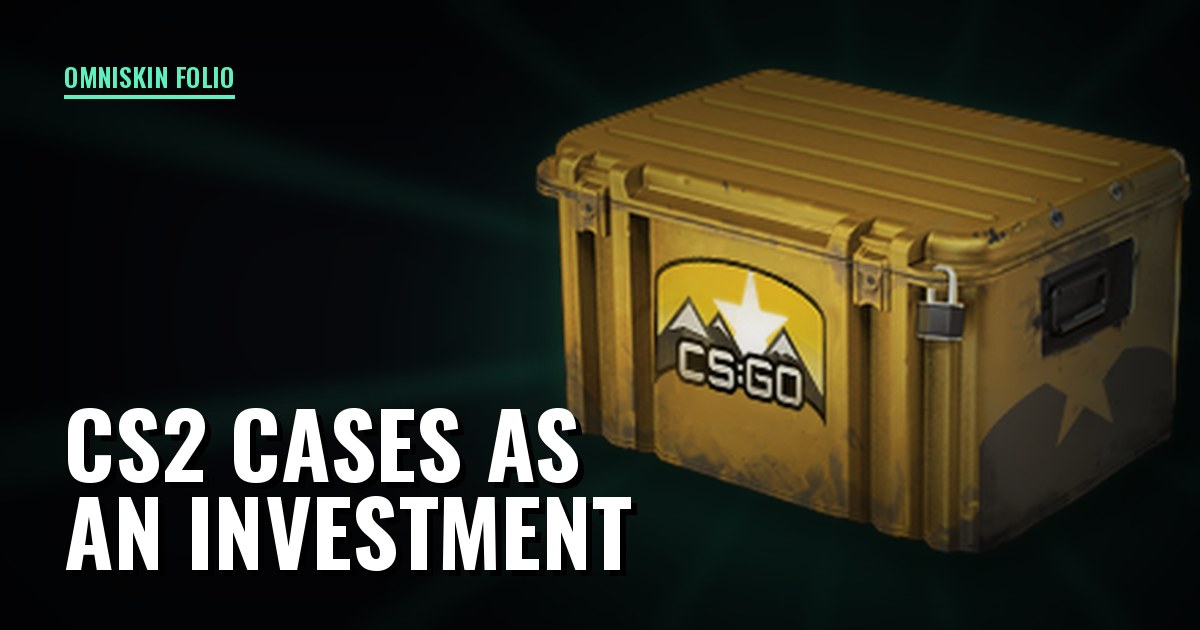
CS2 Cases as an Investment: Why Prices Rise
The mechanics of frozen supply: what happens to a case price once it leaves the active drop pool, the historical return, and where the risks sit.
Cases are the simplest position in this market: no conditions, patterns or stickers to learn, and every copy is identical. And they carry a mechanic almost nothing else has: supply does not grow over time, it shrinks.


The mechanics: why the price rises
A case lives through two phases.
- Active drop. The case drops to players weekly, supply grows faster than demand, and the price sits at the floor — usually cents.
- Rare drop. Valve takes the case out of active rotation. New copies barely arrive, while old ones keep being destroyed by opening. Supply becomes finite and declining.
The second phase is the entire investment idea. The entry point is the transition from the first to the second: the price is still near the floor while the inflow has already stopped.
 Fracture Casebest price: $0.35 · skinport
What the historical benchmarks are
Marketplace research guides quote annual appreciation of roughly 18–35% for cases that have left the drop pool, and 15–25% for their Coverts in mid conditions.
Where those numbers come from matters more than the numbers. They are third-party estimates on private data, not audited returns; they are survivor-biased towards the cases people still talk about; and they were measured on a market that ended before October 2025. The same basket lost about half its value in 38 hours during the crafting update, and 2026 has run the other way — total market capitalization is down close to $2bn since January. Use the range as evidence that the supply mechanism works, never as an expected return.
What makes a case a good position
- Supply status. The main question: does the case still drop or not. Everything else is secondary.
- Contents. Cases with in-demand red skins and knives hold demand better: people open them, which consumes supply.
- Liquidity. Popular cases see hundreds of trades a day, so you can exit within a day. Read that carefully: nearly all of that volume is Steam Market volume, where the fee is 15% and the proceeds stay in the wallet. Exiting into withdrawable money is slower and thinner.
- Entry price. A few cents per copy is what makes diversification cheap — and what makes each individual copy uneconomic to trade. Cases work as hundreds of identical units held for a year, not as something you flip: the fee, the minimum listing price and the withdrawal threshold are fixed costs a $0.30 unit cannot carry.
Risks worth knowing in advance
- Valve's decisions. One company sets the rules. In October 2025, enabling knife crafting through trade-up contracts — five Covert items for a knife — cut market capitalization roughly in half in 38 hours. Cases suffered less than knives, but the episode set the tone. Full breakdown in the article on investing in skins.
- A return to rotation. In theory a case can start dropping again, and the scarcity thesis goes to zero.
- Costs. A 2–8% selling fee on third-party venues plus withdrawal, or 15% of your proceeds on Steam — which is why a Steam exit needs about an 18% move to break even, not 11%.
- Horizon. This is a bet on years, not weeks. Within a quarter a case price can simply stand still.
How to count the result
As everywhere else, profit comes from the money at the exit, not from the tag:
result = sell_price × (1 − fee) − buy_priceAt a 10% fee a case has to rise about 11% just to break even; on a Steam exit, about 18%. Which is why cases only start to pay at moves of tens of percent — that is, over a long horizon.
🔧Value your inventoryfree, no sign-upWhat sets a case apart from other portfolio positions
A case has a property no skin or sticker has: its supply shrinks every day on its own, with no decision from Valve required. Every opened case is gone forever, and new ones stop arriving the moment the case leaves the active drop pool. It is the only position on the market where attrition is built into the mechanics of consumption.
That gives two features that matter for a portfolio.
A case is the simplest position to account for. It has no float, no pattern, no stickers and no wear. Every copy is identical, so the price for the name is a real price rather than an average across incomparable goods. For a portfolio that is a rare luxury: the result computes exactly.
A case is the most liquid of the "investment" positions. There are thousands on the market, they are cheap per unit, and selling one or a hundred is possible on any day. Compare that with a $10,000 knife where the buyer is awaited for weeks.
What a case does not give you
A case does not react to news and does not produce fast moves: its price creeps slowly and predictably. You cannot earn on it within a month — the supply mechanic works on the scale of years, not weeks.
And the main limitation: a case's price is tied to what comes out of it. If the market falls out of love with the contents, the case itself can decline despite the shrinking supply. Attrition helps, but it does not override demand.
A practical strategy
- Watch the drop pool, not the announcements. Valve does not announce rotation: the pool changes quietly and the community works it out afterwards from the Armory line-up and from drop statistics, usually within days. Check the pool after each update, watch daily sales volume on the case, and treat the first weeks after a rotation as the window.
- Build volume across several cases rather than one: the next update can hit a single category.
- Count from the median of real sales, not from the lowest listing.
- Record the purchase price and date — without them a portfolio has no P&L, and you cannot tell whether the strategy works. How we handle it is in the article on portfolio and P&L.
- Do not borrow to hold a position. An asset that can lose half its value in 38 hours does not mix with borrowed money.