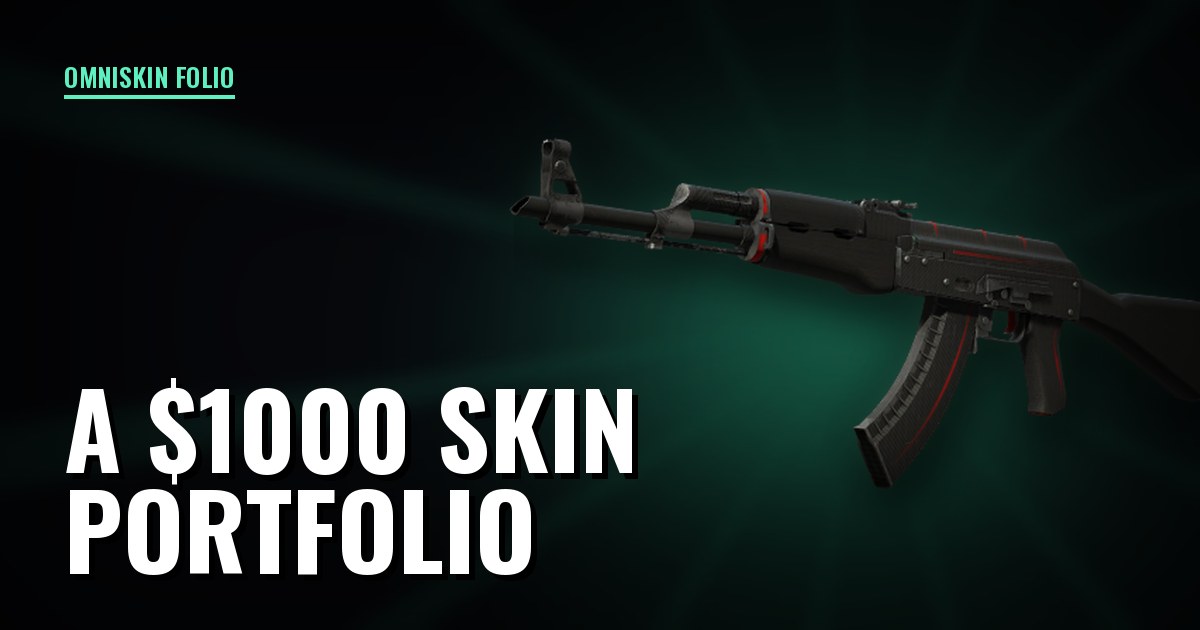
A $1000 Skin Portfolio: Three Versions of the Same Sum
The same amount can be assembled three different ways, and the difference is not in returns but in what you will be able to do a month later. Liquid, mid-range and concentrated portfolios — on live prices, with the honest cost of each choice.
Short version: one sum, three different jobs
"Put $1000 into skins" is not one decision but at least three, and you choose between them by what you will want to do a month from now, not by expected return.
If you might need to be in cash within a day, liquidity is what matters. If the goal is to wait for growth, rarity matters. If you want both, you have to accept they are different things and split the sum.
Below are three builds of the same amount. Prices in the cards are live: they are pulled from our database at the moment you read the page. So there are no invented figures here that will be wrong in a week.
None of the three builds is advice to buy. They are a way to show how one sum changes its properties depending on structure — not a recommendation of specific items.
 AK-47 | Redline
 ★ Karambit | Doppler
 ★ Sport Gloves | Pandora's Box
 Kilowatt Case
 Sticker | Crown (Foil)
Version A. Liquid: many cheap, popular positions
The idea: hold positions that always sell and sell fast. Cases and mass-market skins for common weapons.
 Fracture Casebest price: $0.39 · skinport
 AK-47 | Redline (Field-Tested)best price: $23.98 · skinport
What you get. The ability to be in cash at almost any moment and at almost no discount: such positions always have a buyer, and the gap between the listing price and the instant buyout is the narrowest on the market.
What you pay with. The ceiling. Mass items rise slowly and only along with the whole market; they do not double without a general move. Plus the hassle: a hundred identical positions sell in a hundred operations.
Cases inside this version deserve a separate note. They behave unlike skins: the inflow of new copies stops once a case leaves rotation, and after that supply can only shrink. That makes them the most predictable part of a liquid portfolio, and also the dullest — nothing sharp happens there for years.
Version B. Mid-range: a few items in the middle segment
The idea: three to five positions in the range where buyers still exist but the item already has individuality — wear, pattern, rarity.
 AWP | Asiimov (Battle-Scarred)best price: $73.98 · lis
 M4A1-S | Printstream (Field-Tested)best price: $186.70 · skinport
 USP-S | Kill Confirmed (Minimal Wear)best price: $106.94 · lis
What you get. A compromise: selling takes days rather than hours, but each position has its own price history that is not rigidly tied to the whole market.
What you pay with. The need to understand what you are buying. In this segment price already depends on float and pattern, and buying "by the name" starts costing money.
Version C. Concentrated: one expensive item
The idea: the entire sum in a single top-segment position.
 ★ Karambit | Doppler (Factory New)best price: $1164.89 · skinport
What you get. No hassle and the highest ceiling: rare items move more than the market, and holding them requires no attention.
What you pay with. Liquidity and precision of entry. Few buyers want that specific expensive copy, a sale takes weeks, and the gap between listing and instant buyout is at its widest here. A mistake in judging float or phase hits the whole sum at once rather than a fifth of it.
The three versions in one table
| Property | A: liquid | B: mid-range | C: concentrated |
|---|---|---|---|
| Time to be in cash | hours | days | weeks |
| Loss on an urgent sale | minimal | medium | the largest |
| Requires expertise | almost none | yes | mandatory |
| Growth ceiling | low | medium | high |
| Cost of one mistake | part of the sum | a third of the sum | the whole sum |
| Attention per month | many small operations | little | almost none |
The "cost of one mistake" row matters more than the "growth ceiling" row. A concentrated portfolio loses not when the item fails to grow, but when the item turns out not to be what it was taken for: a different phase, a different wear, a souvenir version instead of the plain one.
What all three have in common
Whatever the version, three things are calculated the same way — and they, rather than the choice of items, usually decide the outcome.
Count the amount in hand, not the price gap: the selling marketplace's fee comes out of the whole trade. Remember there are two prices. The value shown is almost always a listing; for an urgent sale allow for a median loss of about a fifth of the sum. Check trades, not listings: a position with no real sales has no price, however many offers are posted. Account for the hold: an item bought on a marketplace cannot be passed on for a while, and the price lives its own life during that time. Revalue the whole portfolio rather than one position: the sum is what matters, not a single lucky purchase.
Value your inventory against every marketplace at once:
🔧Value your inventoryfree, no sign-upHow to pick your version
The question is not "which returns more" but "what will you do if you need the money".
- The money might be needed at any moment — version A, no alternatives.
- The sum is set aside and you do not plan to touch it — C becomes reasonable.
- You do not know — B, and that is an honest answer: the middle segment forgives mistakes better than the others.
The most common beginner mistake is assembling C while thinking they assembled B. One expensive item instead of five mid-range ones looks more impressive but behaves completely differently: it does not let you exit partially. You cannot sell half a knife.